

A trading edge means your method has positive expectancy: it makes money on average over many trades, after costs. Expectancy blends win rate with the size of wins against losses, so a 35% win rate can beat an 80% one if the winners are large. Over a handful of trades, luck dominates, so you cannot judge an edge from a few results.
What an edge is
An edge is not a magic setup or a secret indicator. It is a method that makes money on average, over a large number of trades. In the language of expectancy, it has a positive expected value per trade after costs.
That definition is unglamorous, and it is the only one that matters. If your method lacks positive expectancy over many trades, conviction on any single trade will not save it.
Why win rate is not edge
Beginners fixate on win rate, but it tells you almost nothing alone. Expectancy combines how often you win with how much you win against how much you lose.
A method that wins only 35% of the time can be highly profitable if its winners are several times larger than its losers. That is good risk-reward. A method that wins 80% of the time can lose money if the occasional losses are huge. A high win rate feels good and can be a trap.
Sample size and variance
Variance wrecks most attempts to judge an edge. Over a small number of trades, luck dominates. A good method can lose over ten trades. A bad one can win over ten. You cannot tell them apart from a small sample.
It cuts both ways. A run of wins can flatter a losing method. A run of losses can bury a winning one and make you quit right before it works. Only a large, honestly recorded sample shows the truth. A trading journal is how you see it.
How lucky can you look
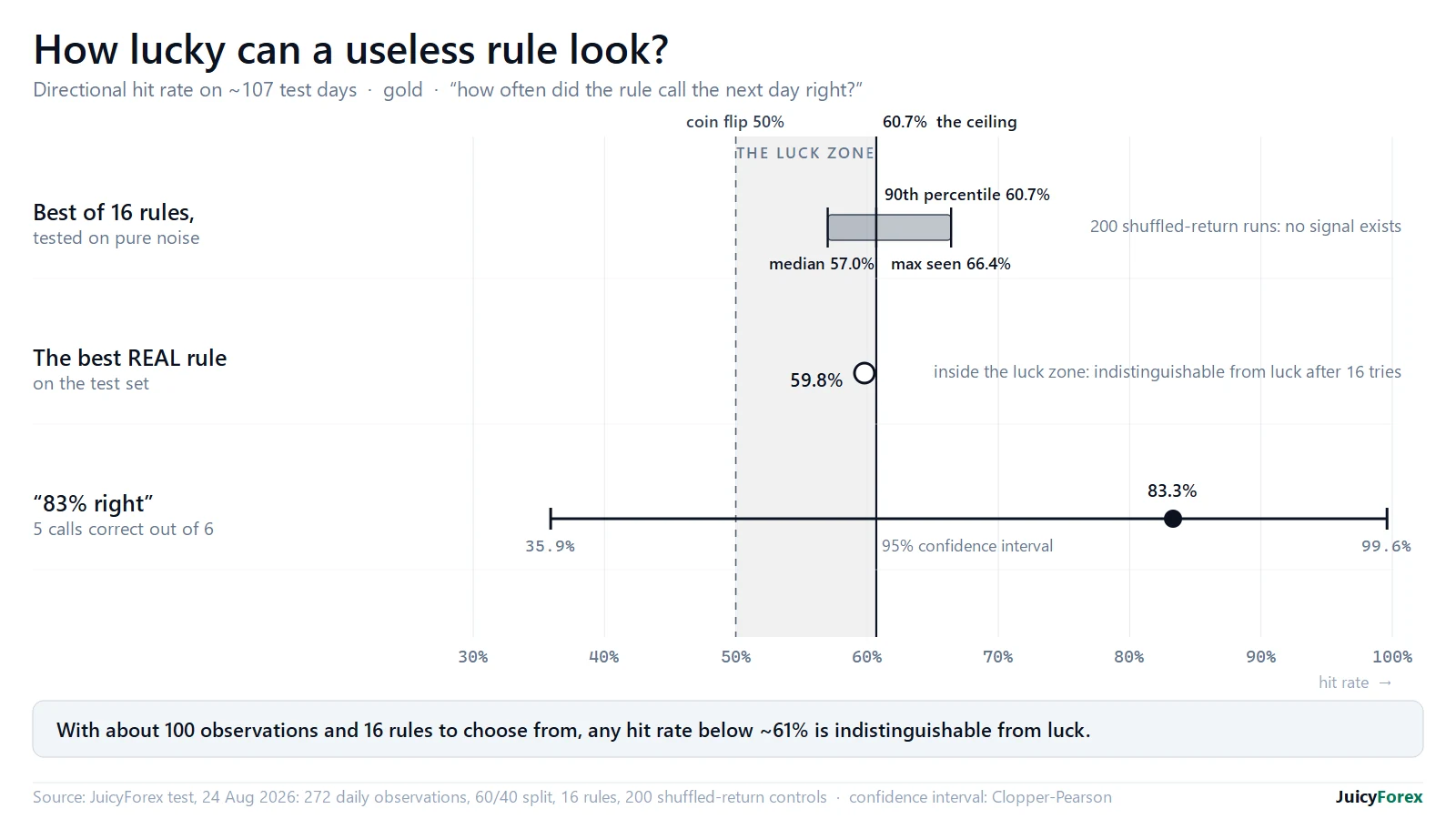
We put numbers on it. We ran 16 simple rules on shuffled returns, where no signal can exist. The best of the 16 scored 57.0% at the median, 60.7% at the 90th percentile and 66.4% at the maximum. The best real rule scored 59.8%.
With around 100 observations, a hit rate below about 61% is indistinguishable from luck. A track record of 5 right calls out of 6 (83%) has a 95% interval from 36% to 99.6%. See what we learned testing gold methods.
How to test for an edge
- Define your method with clear rules.
- Backtest it over many trades and different conditions, including losing periods.
- Track it live in a journal with the same discipline.
- Look at expectancy over a large sample, not the last few results.
Stay humble. An edge is an average, not a promise, and even a real edge brings painful losing streaks. This is education, not advice.
Questions
Can a low win rate still be profitable?
Yes. A method that wins only 35% of the time can be highly profitable if its winners are much larger than its losers. Win rate alone is not edge.
Why can't I judge my system from a few trades?
Variance dominates small samples. A good method can lose over ten trades and a bad one can win over ten. Only a large, honestly recorded sample reveals a real edge.
How many trades do I need to know if I have an edge?
There is no single number. A handful is meaningless, and even a few dozen can mislead. Judge expectancy over a large sample across different market conditions.
70–80% of retail investor accounts lose money trading CFDs. This page is education, not advice. All trade examples are constructed composites.