

A stop loss is a resting order that closes a trade at your maximum acceptable loss. Place it where your trade idea is proven wrong, not at a round dollar figure. That distance then sizes your position, so your risk is fixed before you enter. Set the stop at entry and never move it further away.
Why every trade needs a stop
Without a stop, a losing trade has no defined end. It can grow until it threatens the account. A stop turns open-ended risk into a known, capped number. Everything else depends on that: sizing, risk-reward and expectancy all assume a fixed 1R loss.
Where to place it
Put the stop at the price where your reason for the trade no longer holds. For a long from a support zone, that is a decisive close below the zone. If price gets there, you were wrong, and you want to be out cheaply.
Set the stop at the level first. Then size the position so the distance equals the risk you chose. Do not pick a comfortable dollar amount and squeeze the stop to fit it.
Structure and ATR stops
- Structural. Place the stop just beyond the swing high or low, or the level, that defines your idea. Add a small buffer past the wicks so ordinary noise does not clip you.
- ATR-based. The Average True Range measures recent volatility. A stop a multiple of ATR away is wider when the market moves and tighter when it is calm. A fixed 20-pip stop is too tight in a volatile session and too loose in a quiet one.
The two work together. Use the structural level, then let ATR check the distance.
Gold's fat tails
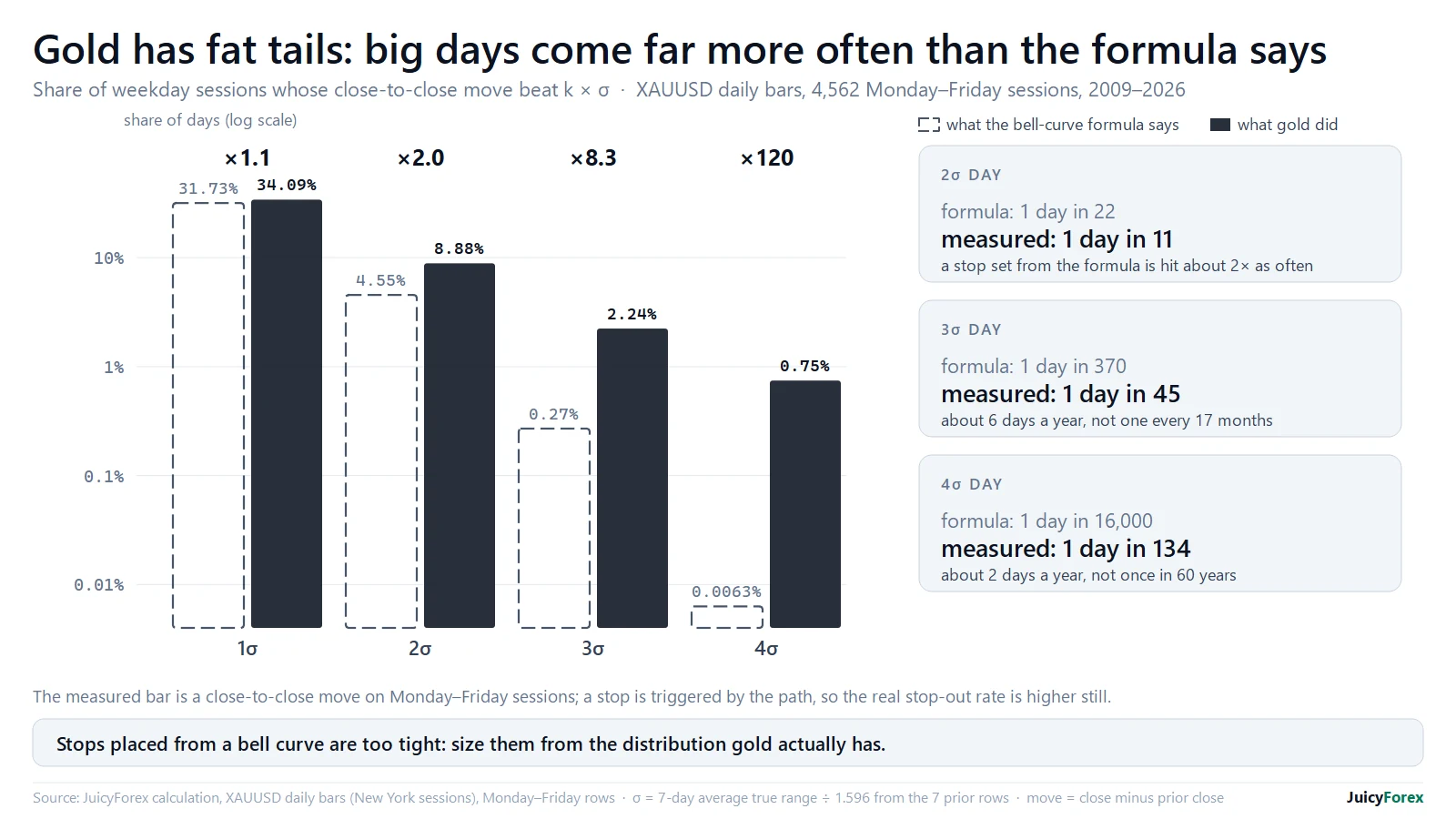
A stop set from a bell curve gets hit more often than planned. Across 4,562 weekday gold sessions, a 2σ move came on 8.9% of days, against 4.55% for the bell curve. A 3σ move came on 2.2% of days, against 0.27%.
Stops are triggered by the path of price, not by the close.
The mistakes that ruin accounts
- Moving the stop away to avoid a loss. It turns a 1R loss into a 3R disaster and breaks your expectancy. A stop moves toward profit, never away.
- Stops too tight. Placed for comfort inside the noise, they clip good ideas before they work.
- No stop at all, or a mental stop you ignore in the moment. If it is not resting in the market, it does not exist.
Trailing and breakeven
Once a trade moves in your favour you can trail the stop behind structure to lock in gains, or move it to breakeven to remove risk. Both are fine, but only in the profitable direction and ideally by rule, not by feeling.
Do not move to breakeven too early. Do it the moment price ticks up and noise will stop you out of winners. Trail against real structure, not every small pullback.
Questions
How do I size a trade from my stop?
Decide the money you will risk, for example 1% of the account. Measure the stop distance in pips. Choose the lot size so that distance equals your risk.
Should I move my stop loss?
Only toward profit. Never move it further away to avoid a loss. That turns a controlled 1R loss into a much larger one.
Is a mental stop loss okay?
No. A stop that is not resting in the market is easy to ignore when a trade goes against you, which is when discipline fails. Place a real stop order at entry.
70–80% of retail investor accounts lose money trading CFDs. This page is education, not advice. All trade examples are constructed composites.