

The spread is the difference between the price you can sell at, the bid, and the price you can buy at, the ask. It is a real cost. The moment you open a trade you are down by the spread. On EUR/USD it is often a fraction of a pip, and on exotics it can be many pips. Liquid majors in active hours keep it small.
Bid and ask
Every pair has two prices. The bid is what a buyer in the market will pay you, so it is the price you sell at. The ask, or offer, is what a seller wants, so it is the price you buy at. The ask is always higher.
You always buy high and sell low relative to the mid-price. That gap is not a glitch. It is how the market and your broker are paid for providing liquidity.
Why the spread is a cost
The spread is ask minus bid. If EUR/USD shows 1.08404 / 1.08414, the spread is 1.0 pip. Quoted in pips, it is the most direct measure of what a trade costs to enter. A new long position starts with a small loss equal to the spread.
It is the most overlooked cost because there is no separate charge. It is baked into the price. Spread cost equals spread in pips times pip value times lots. One standard lot of EUR/USD at a 1-pip spread costs about $10 to enter. A wide spread can erase the edge of an otherwise good strategy, especially for scalpers.
Variable and fixed spreads
Most brokers offer variable spreads that widen and narrow with conditions. They are usually tighter in normal markets but blow out during news and thin liquidity. Fixed spreads trade a slightly higher average for predictability.
Some accounts charge a raw near-zero spread plus a commission. Compare the all-in cost, not the headline spread.
What widens the spread
- Session. Tightest in London and the London/New York overlap, wider in quiet hours. See market hours.
- News. Around high-impact releases spreads can widen sharply for seconds to minutes.
- Instrument. Majors are tight and exotics are wide, because liquidity differs.
A measured example: gold
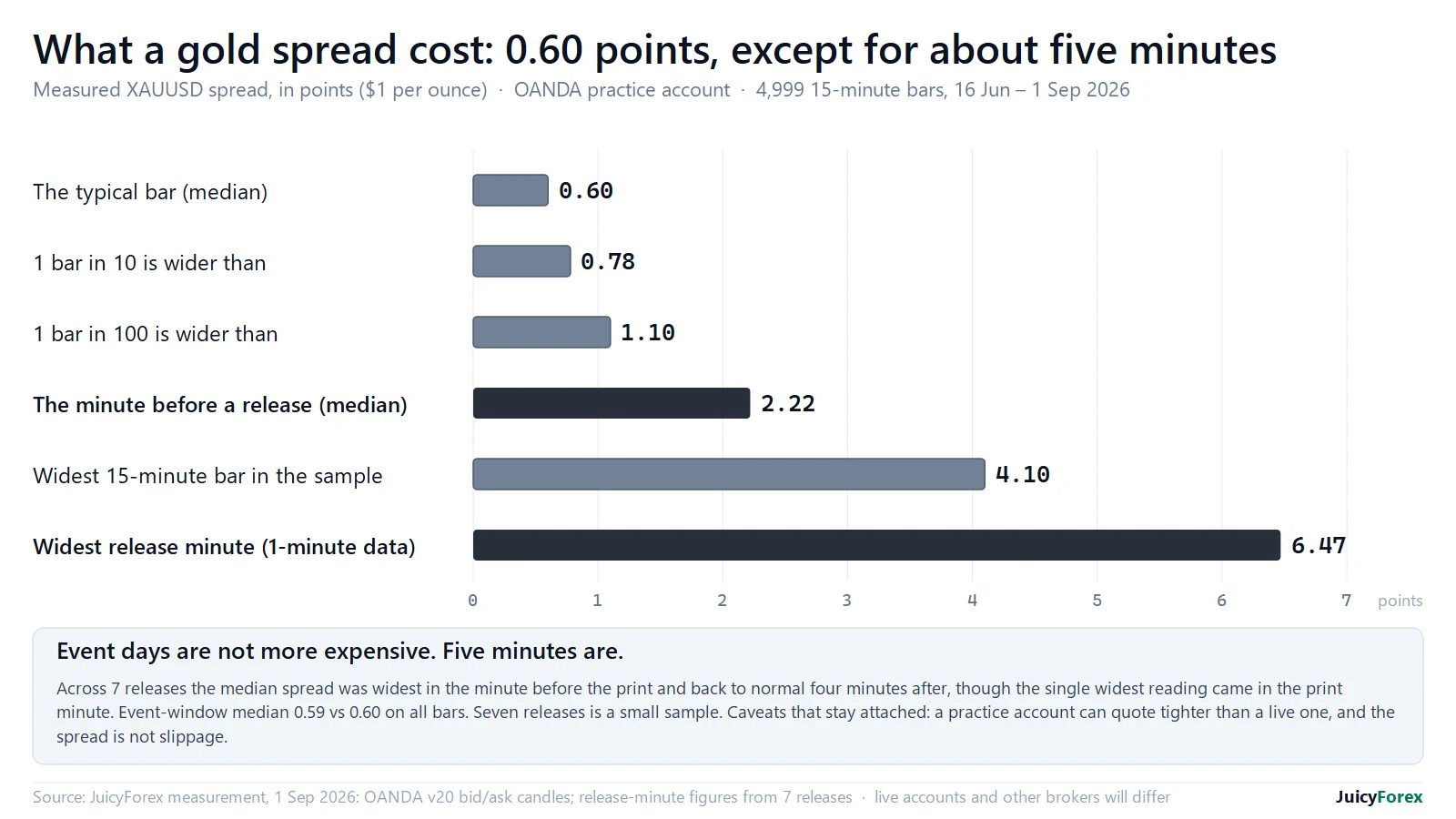
We measured 4,999 15-minute bars from OANDA's practice feed, 16 June to 1 September 2026. The median XAUUSD spread was 0.60 points, the 90th percentile 0.78 and the 99th 1.10. Across seven releases the median was 2.22 points in the minute before the print, and back to normal four minutes later.
A practice account can quote tighter than a live one, and the spread is not slippage. Treat these as a floor, not a promise. See what we learned testing gold methods.
How to reduce spread cost
You cannot remove the spread, but you can avoid paying more than you need to. Trade liquid majors, during active sessions, and avoid trading straight into high-impact news unless that is your plan.
Favour setups with wider targets, where a 1-pip spread is trivial against a 60-pip move, over hyperactive scalping where the spread is a large share of each trade.
Questions
Is the spread a fee?
Effectively yes. There is no separate charge, but you enter at the ask and exit at the bid. The cost is the spread in pips times pip value times lot size.
Why do spreads widen?
When liquidity falls: quiet hours, high-impact news and less-traded pairs like exotics. They are tightest on majors during the London and New York sessions.
What is a good spread in forex?
On EUR/USD, under about 1 pip is normal and competitive. Raw-spread accounts can be a fraction of a pip plus commission. Always compare the all-in cost.
70–80% of retail investor accounts lose money trading CFDs. This page is education, not advice. All trade examples are constructed composites.