

Gold is driven mainly by real interest rates, which are the interest rate minus inflation. Gold pays no yield, so rising real rates tend to push its price down and falling real rates tend to support it. The US dollar, inflation and Fed policy, safe-haven demand and central-bank buying move gold around that anchor.
The big picture
Gold has no earnings, no dividend and no coupon. Its price is therefore not about cash flows. It is about what else your money could be doing and how much people want a safe store of value. Every driver below answers one of those two questions.
You do not need to forecast. You should know which way the wind is blowing before you trade.
Real interest rates
The most important lever is the real interest rate: the nominal rate minus expected inflation. When real yields on safe assets like government bonds are high, holding gold means giving up that return. Its opportunity cost rises and gold tends to fall.
When real yields fall or turn negative, that cost disappears and gold often rises. If you watch one thing behind gold, watch real yields. Most other drivers work through them.
The dollar, inflation and the Fed
Gold is priced in dollars. A stronger dollar pressures gold and a weaker dollar supports it. The link is real but not mechanical, and there are stretches where gold and the dollar rise together. Treat it as a strong tendency, not a law. More in the gold guide.
Inflation matters through real yields. What counts is inflation relative to interest rates. The Federal Reserve is gold's most important audience. When it signals higher rates to fight inflation, gold often struggles. Gold can fall during high inflation if rates are rising aggressively.
Oil: measure the sign
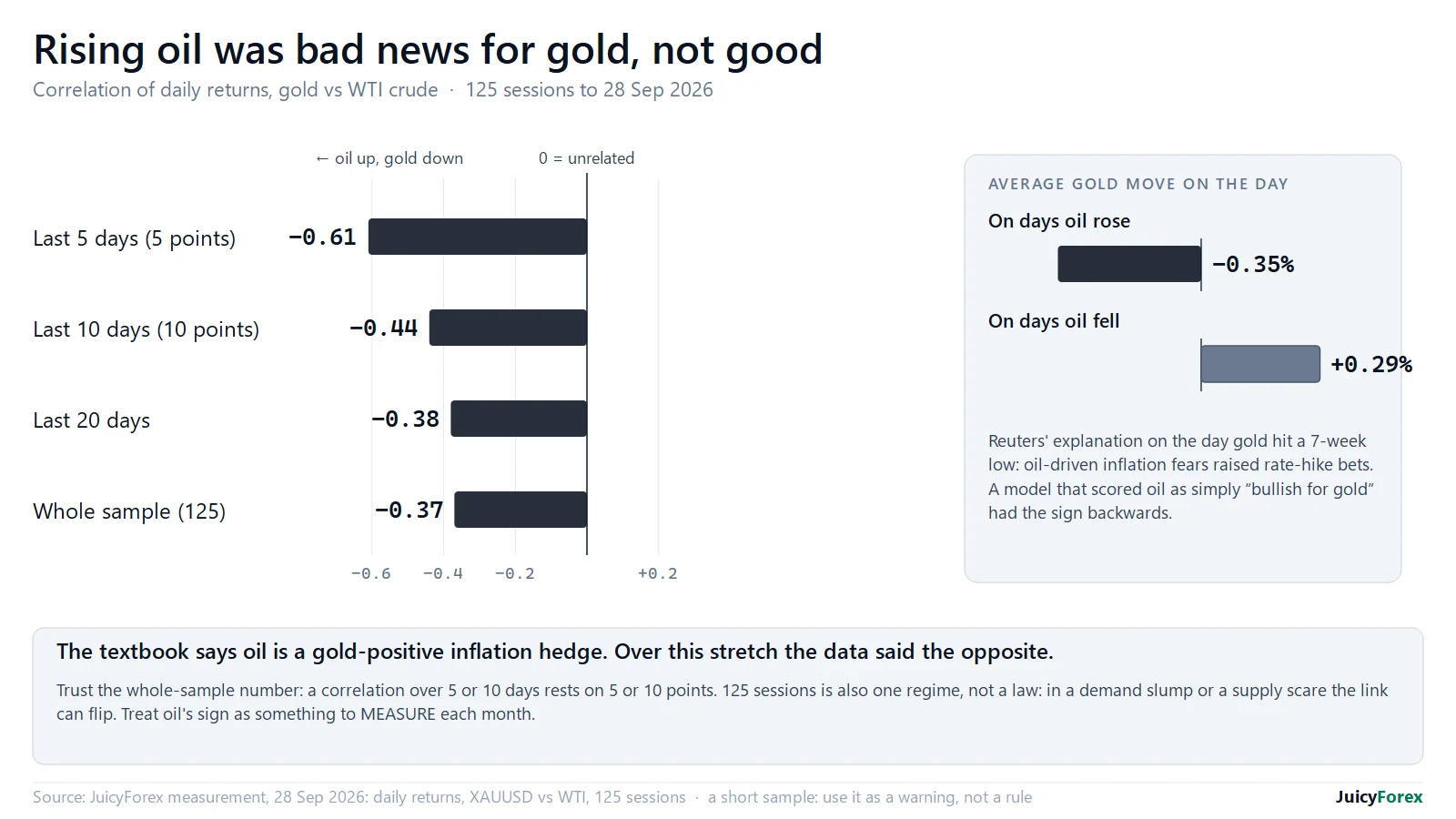
Oil is often listed as a gold-positive inflation hedge. Over 125 sessions to 28 September 2026, gold and WTI daily returns were negatively correlated at every window: −0.37 over the whole sample. Gold averaged −0.35% on days oil rose against +0.29% on days oil fell.
One regime is not a law. Measure the sign before you rely on it. See what we learned testing gold methods.
Safe-haven demand and central banks
In times of fear, such as financial stress, war or geopolitical shocks, investors move into gold as a store of value. This bid can spike the price quickly and sometimes overrides the yield and dollar story for a while. It is event-driven and hard to time. Respect gold's volatility rather than fade sharp moves on instinct.
Central banks hold gold as a reserve. Their net buying or selling is a slower but powerful force, and sustained official-sector demand has underpinned gold for long stretches. Mine supply changes slowly and rarely drives short-term moves. This is backdrop, not a timing tool.
Questions
What is the main driver of the gold price?
Real interest rates. Because gold pays no yield, rising real rates raise the opportunity cost of holding it and tend to push it down. Falling real rates support it.
Is gold a good inflation hedge?
Indirectly. What matters is inflation relative to interest rates. Gold can fall during high inflation if the central bank raises rates aggressively, because rising real yields outweigh the inflation.
Why does gold spike during crises?
It is a safe-haven asset. In financial stress, war or geopolitical shocks, investors buy gold as a store of value. That can quickly and temporarily override the yield and dollar drivers.
70–80% of retail investor accounts lose money trading CFDs. This page is education, not advice. All trade examples are constructed composites.