

Gold moves hardest on US releases that shift rate expectations: CPI (inflation), NFP (jobs) and FOMC (Fed) decisions. In the seconds around them, spreads widen, liquidity thins and price can gap through stops. For most traders the right approach is not to trade the instant of release. Be flat before it, or wait for the dust to settle.
Why gold reacts to news
As the drivers guide explains, gold trades off real interest rates and Fed expectations. Any release that changes what markets expect from the Fed moves gold at once. It often moves more sharply than currency pairs, because gold has no yield to cushion the repricing.
That is why a single inflation print can send XAUUSD dozens of dollars in minutes. The news reprices the asset's core driver in one step.
The releases that matter
- CPI. Inflation data, the most direct input to real-yield expectations.
- NFP. The monthly jobs report, a gauge of economic strength and Fed pressure.
- FOMC. The Fed's rate decision and, just as important, its tone and projections.
Know when these are due in every week you trade gold. Trading without a news calendar open is trading blindfolded.
What happens in those seconds
At the moment of release, liquidity providers pull back. Spreads can widen from normal to many dollars, and price can jump between levels with nothing trading in between. A stop placed in that window may fill far worse than its price, which is slippage, or be skipped by a gap entirely.
This is not a malfunction. It is what a market does when everyone recalculates at once. The risk you think you have on can briefly be much larger.
How long it lasts
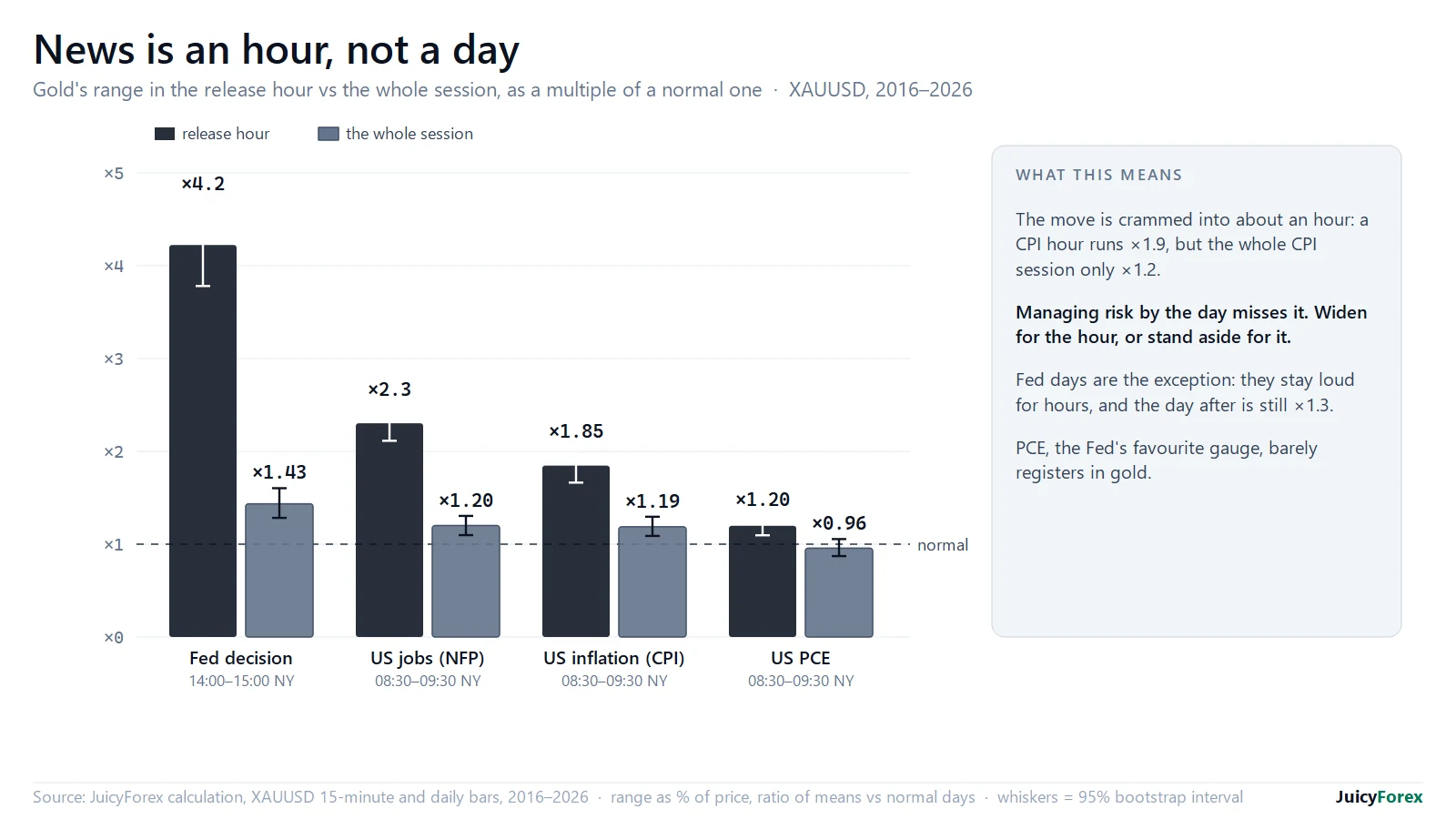
Across 2016 to 2026, gold's range in the hour after a release was 4.2 times normal for the Fed decision, 2.3 times for US jobs and 1.9 times for CPI. Over the whole session those shrink to 1.4, 1.2 and 1.2 times.
The move is crammed into about an hour. Managing risk by the day misses it. Widen for the hour, or stand aside for it. Spreads follow the same shape: 0.60 points on a typical bar, but a median of 2.22 in the minute before a release.
Two honest approaches
- Stand aside. Be flat before the number. Do not carry event risk you cannot control.
- Trade the aftermath. Let the spike play out. Wait for spreads to normalise and a clear level or reaction to form. Then trade it with a normal stop.
What almost never works for beginners is trading the instant of release, guessing direction into a spread that has blown out. The edge in news is usually in the reaction, not the announcement.
Managing the risk
If you hold gold through news, assume your effective risk is larger than your stop implies. Size down, or reduce exposure before the event. Never add size into a release hoping to catch the move. That is how a normal loss becomes a drawdown you did not plan for.
The 1% risk rule assumes your stop works as intended. Around high-impact news that assumption weakens. Gold can also gap on Sunday's open if something happens while the market is shut. If you hold over the weekend, size to survive a gap against you.
Questions
Should I trade gold during news releases?
For most traders, no. Not at the instant of release, when spreads blow out and price gaps. Be flat before the news, or wait for the spike to settle and trade the structure with normal risk.
What is slippage in gold trading?
Slippage is an order filling at a worse price than expected because price moved through the level with little liquidity. It is common around high-impact news.
70–80% of retail investor accounts lose money trading CFDs. This page is education, not advice. All trade examples are constructed composites.