

Non-Farm Payrolls (NFP) is the US jobs report, out on the first Friday of each month. It moves gold through what it implies for Fed policy. Strong jobs and wages point to a more hawkish Fed and tend to pressure gold. Weak data tends to support it. Wages and revisions can matter more than the headline job count.
What the jobs report is
NFP reports the net change in US jobs in the previous month, excluding farm and a few other categories. It is one of the two or three biggest scheduled market events, alongside CPI and the Fed.
The reason is that jobs are half of the Fed's mandate. A strong labour market gives the Fed room to keep policy tight. A weakening one is a classic argument for cutting rates. So the report feeds directly into the rates story that drives gold.
More than the headline number
The report bundles several market-movers, and the headline is often not the most important. Watch these:
- Average hourly earnings. Wage growth feeds inflation and can matter more than the job count.
- The unemployment rate, read alongside the participation rate.
- Revisions to prior months, which can quietly flip the whole story.
A strong headline with soft wages and big downward revisions is not really strong.
How it moves gold
Strong jobs or hot wages suggest a more hawkish Fed, higher real yields and a firmer dollar. That is a headwind for gold. Weak jobs or soft wages point to a more dovish Fed and tend to support gold.
The surprise versus expectations drives the reaction, not the raw number. A big payrolls figure that was already expected may do little.
The data: an hour, not a day
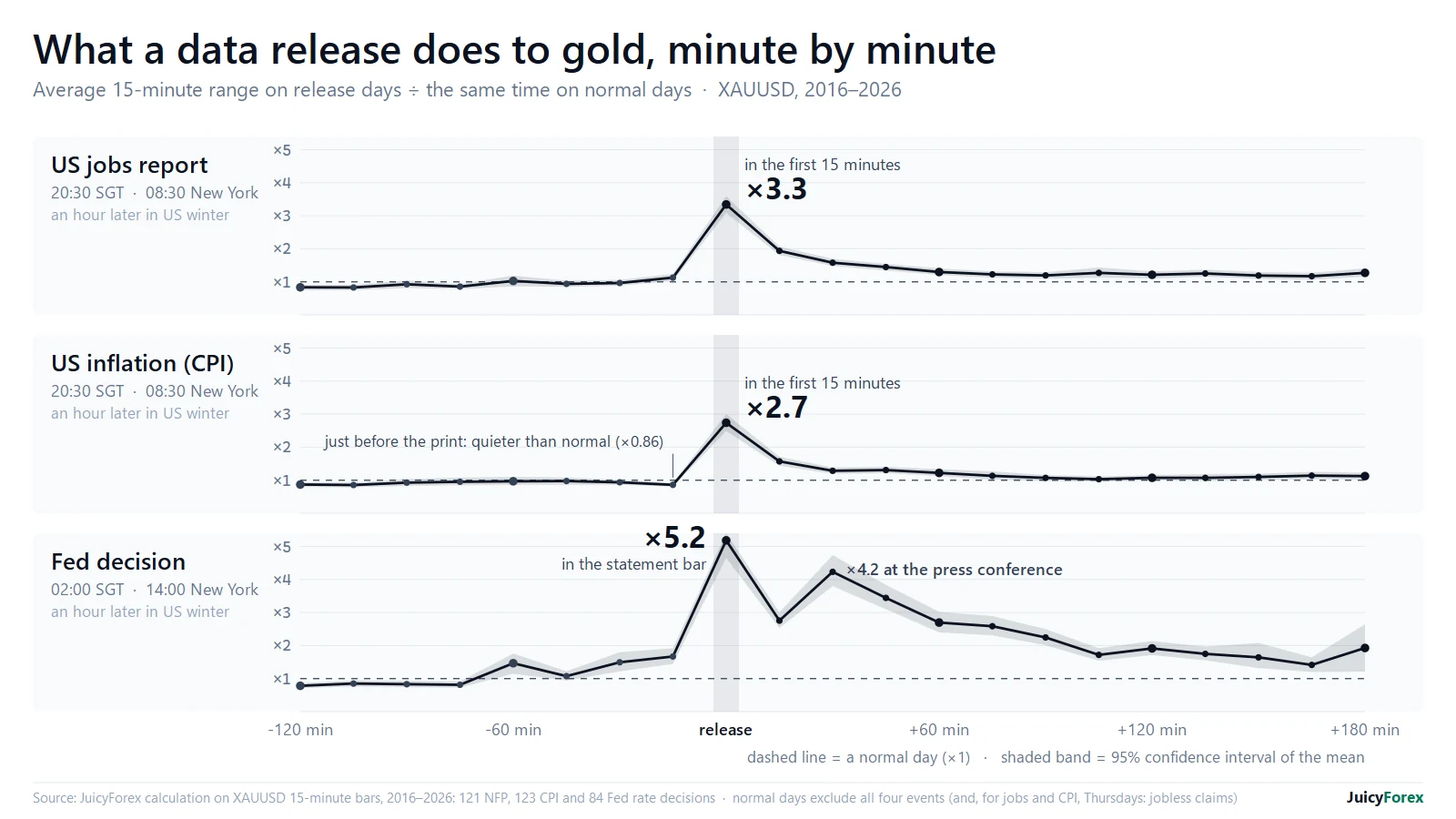
We measured gold's range around jobs reports from 2016 to 2026. The first 15 minutes after the print run about 3.3 times a normal 15 minutes, and the whole hour about 2.3 times. By 90 minutes it has fallen to about 1.2 times normal. The jobs-day session as a whole is also only about 1.2 times normal.
That is why a study of daily closes would say jobs do not matter. Stops are hit by the path, not the close. See the full data.
The regime nuance
The reaction depends on what the market is worried about. In a normal, inflation-focused regime, weak jobs are good for gold because the Fed turns dovish. In a growth-scare regime, very weak jobs can trigger broad risk-off, and gold can be bid as a safe haven at the same time as the dollar.
Do not memorise that weak jobs means gold up. Read the actual reaction across gold, yields and the dollar.
The first-Friday whipsaw
NFP produces some of the sharpest moves of the month. Gold can lurch on the headline, then reverse as traders digest wages and revisions. The thin, fast first seconds are where stops get run. Expect two-way volatility, size smaller and use structural stops. See trading gold around news.
Questions
Is the headline job number the most important part?
Often not. Average hourly earnings and revisions to prior months can matter more than the headline payrolls figure.
Why did gold rise on one weak report and fall on another?
The reaction is regime-dependent. Weak jobs are dovish in an inflation-focused regime. In a growth scare, gold can be bid as a haven or, in a liquidity scramble, sold. Read the actual reaction.
Should I trade gold on NFP?
This is education, not advice. Expect violent two-way moves, use smaller size and wider structural stops, and never exceed your usual risk cap.
70–80% of retail investor accounts lose money trading CFDs. This page is education, not advice. All trade examples are constructed composites.