

ICT is a body of trading ideas popularised by the Inner Circle Trader. It overlaps heavily with SMC and adds its own vocabulary, such as kill zones and the judas swing. The useful parts are the liquidity focus and session timing. The caveats are heavy jargon, fluid concepts that are hard to test, and a lot of marketing.
What ICT is
ICT is a set of concepts taught by a trader known as the Inner Circle Trader. Much of modern SMC branding descends from it. The shared foundation is the same: price is driven by institutions targeting liquidity, and traders try to read that through structure, order blocks and imbalances.
ICT layers its own extensive vocabulary on top, which is both its appeal and its problem.
The distinctive ideas
- Kill zones. Session windows around the London and New York opens, said to offer higher-probability setups.
- Optimal trade entry. A Fibonacci-based entry zone within a move.
- Judas swing. A false early move that traps traders before the real move begins.
The most useful is the time-of-day emphasis, because it connects to something real. Volatility and liquidity do concentrate around the London and New York sessions.
What has merit
Strip away the branding and a few ideas are sound. The liquidity focus is real, because markets do run obvious stops. Session-timing awareness is genuinely useful. A structured, defined-risk entry framework is better than trading on impulse. These overlap with plain, classic trading wisdom. They are the parts worth keeping.
The caveats
ICT is very jargon-heavy and its concepts are fluid. They get refined and reinterpreted, which makes them hard to pin down and harder to backtest rigorously. That fluidity means the framework can be made to explain almost any chart after the fact.
It is also surrounded by a large course-and-signals marketing ecosystem. Popularity is not proof, and no framework is a shortcut to consistent profit.
The look-ahead trap
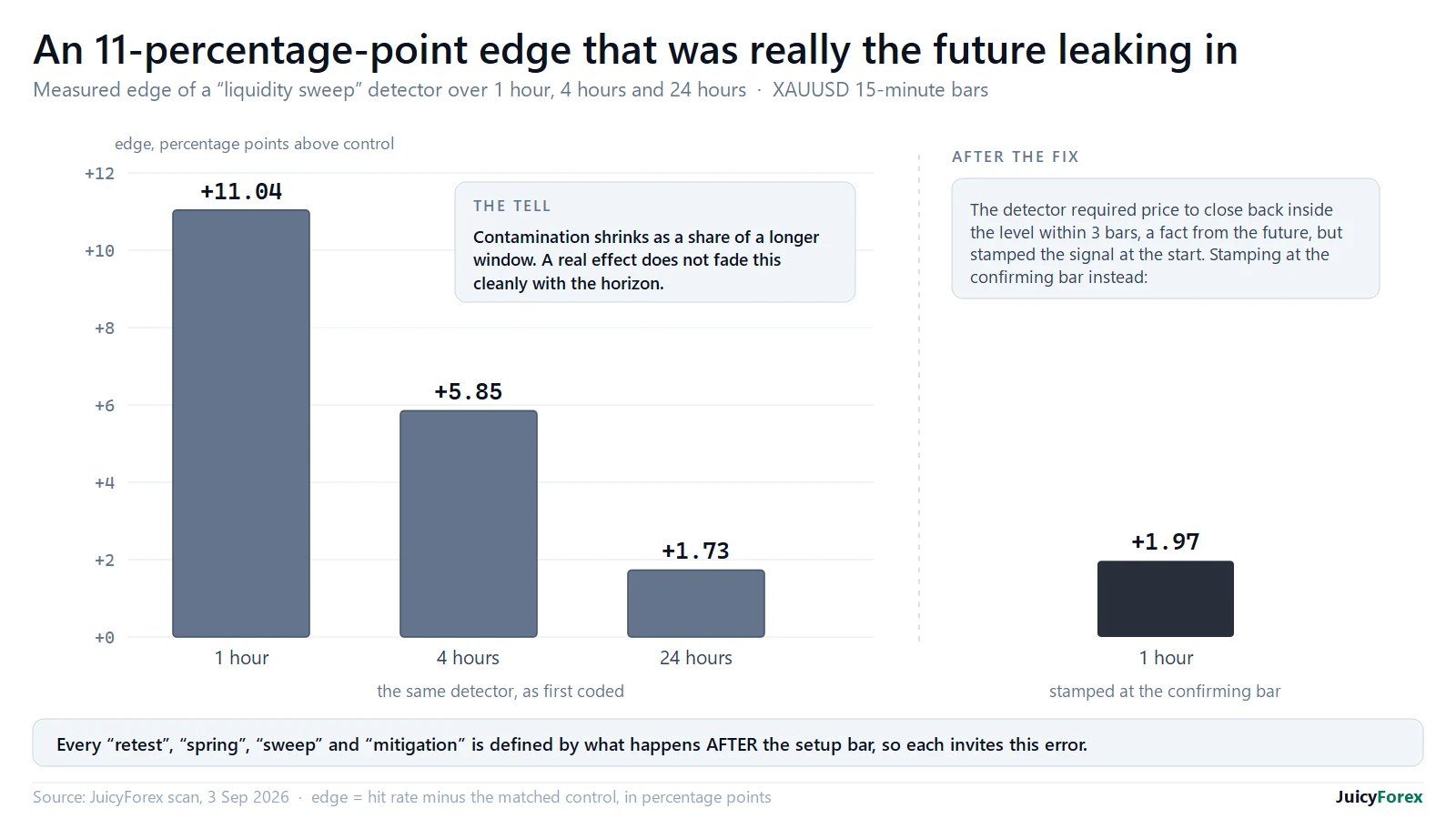
ICT concepts are defined by what happens after the setup bar. A sweep is confirmed by price closing back inside. That is exactly how a backtest manufactures an edge.
Our first scan of a liquidity-sweep detector reported +11 percentage points of hit rate over one hour. It was the future leaking in. The tell was the decay: +11.04, +5.85 and +1.73 as the horizon grew from one hour to four to 24. Stamping the signal at the confirming bar collapsed it to +1.97. See what we learned testing gold methods.
Using ICT sensibly
Take the useful ideas, which are liquidity, session timing and defined risk, and understand the plain truths beneath the vocabulary. Do not collect jargon for its own sake, and do not believe marketing that says any of it guarantees results. Your risk is set by your stop and size, not by a label on a candle. Education, not advice.
Questions
What is an ICT kill zone?
A session time window, typically around the London and New York opens, that ICT says offers higher-probability setups. The underlying truth is real: liquidity and volatility concentrate around those sessions.
Is ICT better than SMC?
They overlap so heavily that the distinction is mostly branding. Both share a liquidity-and-structure foundation. Neither offers a guaranteed edge.
Can you backtest ICT?
Rigorously, it is difficult, because the concepts are fluid. That lets the framework fit almost any chart in hindsight, a reason to doubt confident performance claims.
70–80% of retail investor accounts lose money trading CFDs. This page is education, not advice. All trade examples are constructed composites.