

An order block is the last opposing candle before a strong, structure-breaking move. SMC traders treat it as potential support or resistance when price returns. A fair value gap (FVG) is a three-candle gap left by a fast move. Both have real logic, but both are subjective and fail regularly. They are zones of interest, not guaranteed reversal points.
What an order block is
In SMC theory, an order block is the last opposing candle, or zone, before a strong move that breaks structure. A bullish order block is the last down-candle before a strong rally. A bearish one is the last up-candle before a strong drop. The idea is that large institutional orders were placed there, so price reacts when it returns.
Honestly framed, it is largely a refinement of supply and demand. The useful, observable part is that the origin of a strong move often acts as support or resistance later. The "institutions placed orders here" story is an interpretation on top.
What a fair value gap is
A fair value gap, also called an imbalance, is a three-candle pattern. A strong move leaves a gap that price did not fully trade through: the space between the first candle's wick and the third candle's wick around a large middle candle.
The theory is that markets tend to return to fill these imbalances before continuing. Traders watch FVGs as pullback and entry zones, often combined with an order block for confluence.
How to use them
Use both as zones of interest in line with the higher-timeframe bias, not as standalone signals. The strongest setups are where an order block, an FVG and a liquidity level line up. That is confluence, not a single magic level.
The far edge of the zone gives an objective place for your stop. That is genuinely useful for defining risk.
The honest limits
Tutorials often skip this. Selecting order blocks and FVGs is subjective: which candle, how big a zone. Both fail regularly. Price blows through order blocks all the time, and plenty of FVGs never fill, or not for a long time. "Price fills the gap" is a tendency, not a rule, and it is easy to cherry-pick the ones that worked in hindsight.
Use them as context, define your risk at the zone edge, and never assume a labelled zone must hold. Education, not advice.
What we measured
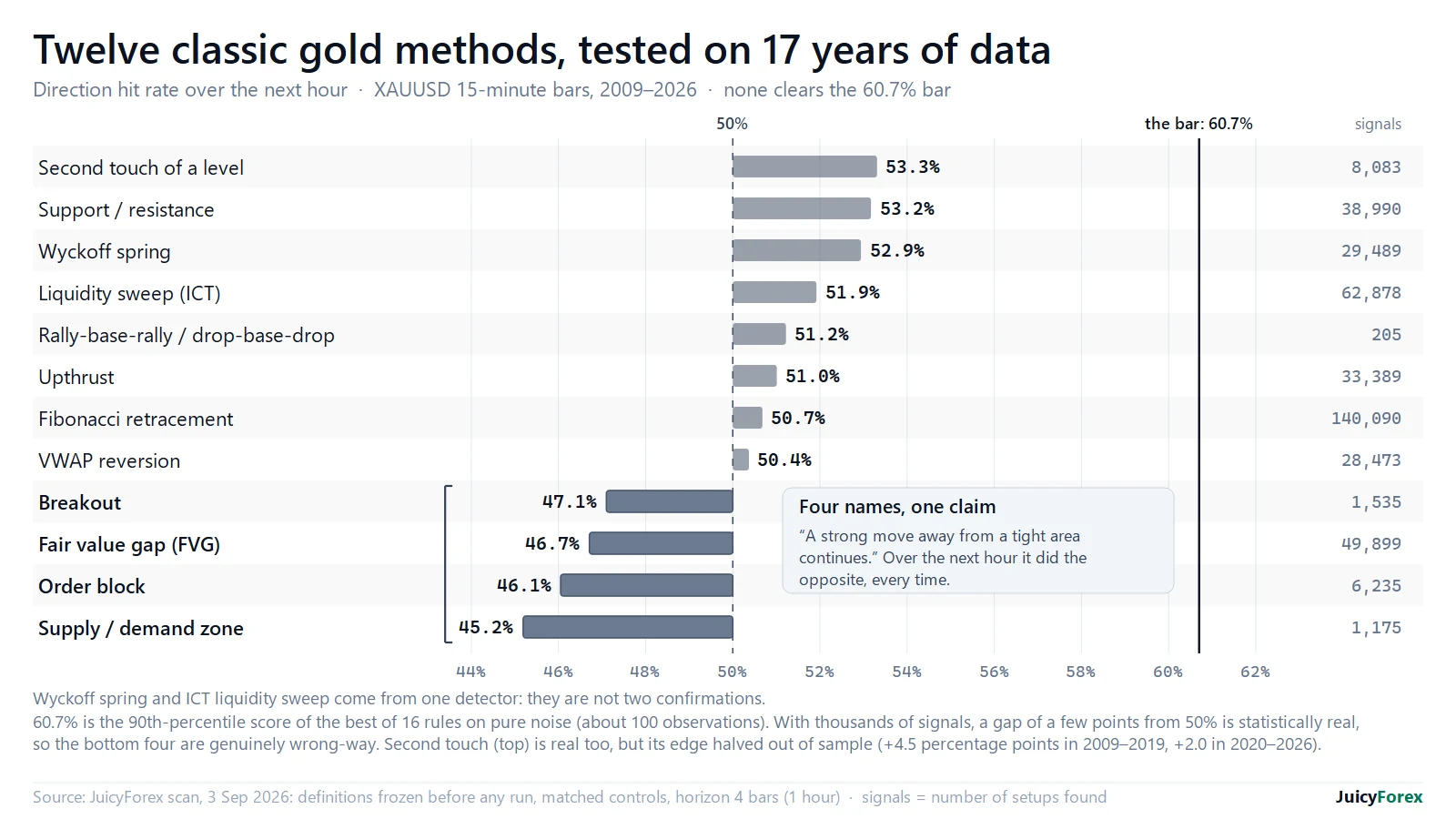
We scanned twelve popular concepts, including these two, on 17 years of 15-minute gold, with definitions frozen before any run. The hit rate over the next hour was 46.1% for order blocks (6,235 signals) and 46.7% for fair value gaps (49,899). A coin gives 50%, and the bar to clear was 60.7%.
Price more often went against the method's direction than with it, and over 24 hours the effect disappears. That does not make them useless as context. It means the mechanical rule that price continues away from the zone went the wrong way at this horizon. See all twelve methods.
Questions
Do order blocks and FVGs always work?
No. Both are subjective to identify and fail regularly. Many FVGs never fill. They are zones of interest, not guaranteed reversal points, and easy to cherry-pick in hindsight.
Are order blocks just support and resistance?
Largely, yes. The testable part is that the origin of a strong move often acts as support or resistance later. The institutional-order story is an interpretation layered on top.
How do I trade an order block safely?
This is education, not advice. Use it as a zone in line with the higher-timeframe trend, look for confluence, and define your risk with a stop beyond the zone. Never assume it must hold.
70–80% of retail investor accounts lose money trading CFDs. This page is education, not advice. All trade examples are constructed composites.