

Smart Money Concepts (SMC) is a price-action framework built on the idea that large institutions move price toward pools of liquidity: clusters of stop-loss orders above obvious highs and below obvious lows. The useful parts are its focus on liquidity, market structure and where predictable stops sit. It is heavily marketed, re-labels classic theory, and offers no guaranteed edge.
What SMC is
SMC is a way of reading charts based on the premise that markets are moved by large "smart money" players. These institutions accumulate and distribute positions and, the theory says, engineer moves to fill their large orders. SMC traders try to read the footprints of that activity through structure, liquidity and a set of specific chart patterns.
It is taught by countless courses and signal sellers. A concept being widely sold is not evidence that it works.
The core idea: liquidity
SMC argues that price moves toward liquidity, the clusters of stop-loss and pending orders that sit in predictable places. These are just above an obvious high, just below an obvious low, and around round numbers. The claim is that smart money pushes price into these pools to fill size, then reverses.
Whether or not the institutional story is literally true, the observation is real. Price often sweeps obvious highs and lows before reversing. The practical lesson: a stop placed at the most obvious level sits exactly where liquidity tends to get taken.
The building blocks
- Market structure: trend read through higher highs and lows.
- Break of structure and change of character: continuation versus possible reversal.
- Liquidity: the stop pools above and below.
- Order blocks: zones where institutional orders supposedly sit.
- Fair value gaps: price imbalances the theory says get filled.
We cover the practical ones in order blocks and fair value gaps and liquidity and market structure.
The honest assessment
What has merit: markets really do hunt liquidity, and reading structure is a real skill.
The valid criticisms:
- It is jargon-heavy and often re-brands classic ideas, such as support and resistance and supply and demand.
- Its "institutions did this" narrative is unfalsifiable and can be fitted to almost any chart in hindsight.
- It does not guarantee an edge. No framework does.
What we measured
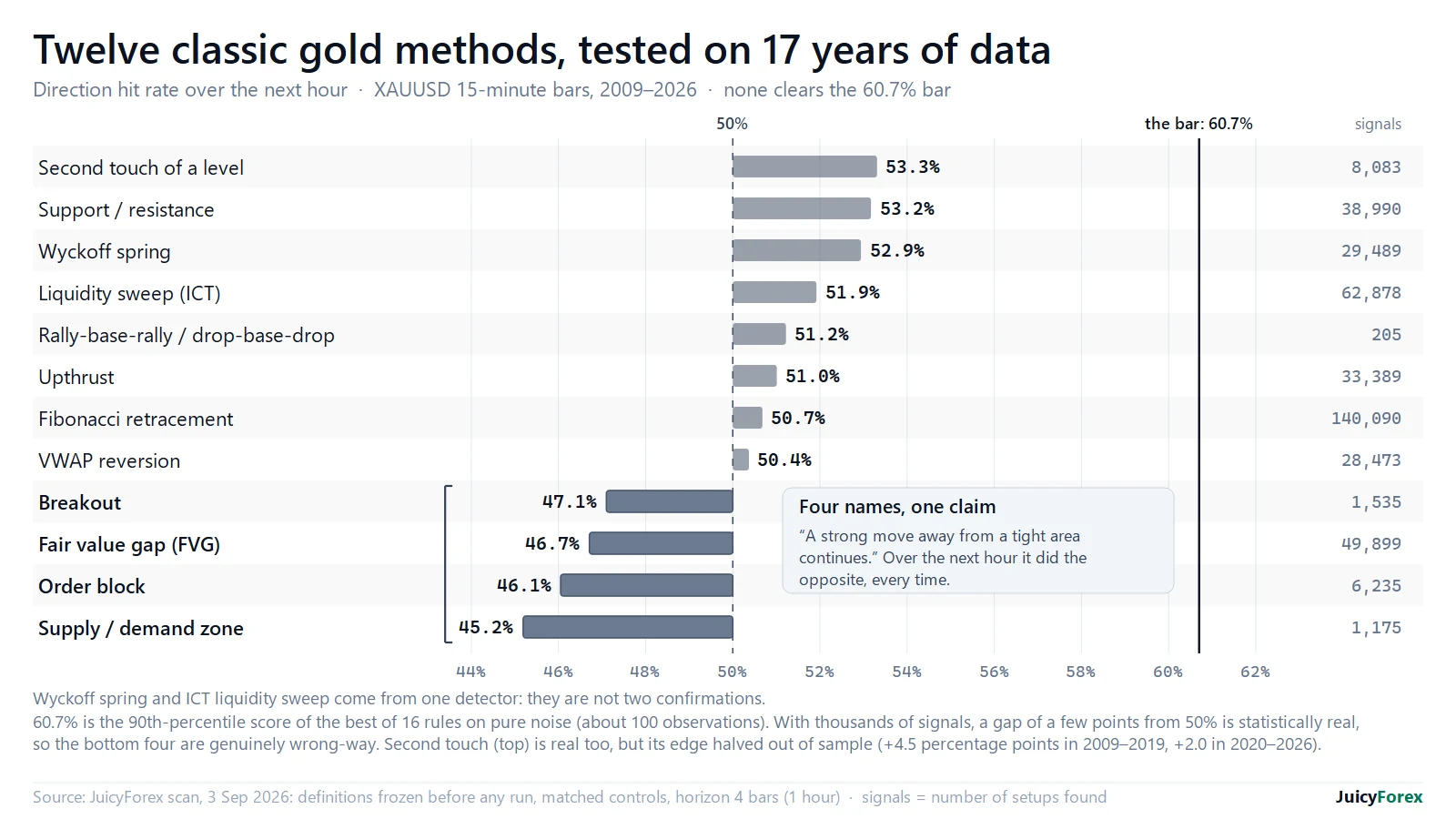
The claims become testable once the definitions are fixed. We froze twelve, then ran them on 17 years of 15-minute gold. Liquidity sweeps scored 51.9% (62,878 signals) and Wyckoff springs 52.9%. That is slightly above a coin, but nowhere near the 60.7% bar. Order blocks, fair value gaps, breakouts and supply/demand zones scored 45-47%, below a coin flip.
A sweep and a spring come from one detector, so they are one signal, not two confirmations.
How to learn it sensibly
Learn the useful mechanics: liquidity, structure and defined-risk entries. Translate the jargon back into the plain ideas underneath. Ignore anyone selling SMC as a secret or a guaranteed system.
Whatever you read on a chart, the risk on any trade is decided by your stop, your size and your risk-reward, never by a belief that you know what institutions are doing. This is education, not advice.
Questions
Does SMC actually work?
Its focus on liquidity and structure is useful, but it offers no guaranteed edge. Its institutional-intent story is unfalsifiable, so treat confident claims with caution.
Is SMC just support and resistance with new names?
Partly, yes. That does not make the ideas useless. Learn the plain concepts underneath the jargon.
Should I pay for an SMC course?
Be wary. SMC is heavily marketed, often with false certainty. No course can sell you a guaranteed edge. Judge a course on its honesty about risk.
70–80% of retail investor accounts lose money trading CFDs. This page is education, not advice. All trade examples are constructed composites.